
The creative skills worth listing on a resume are the ones that show how you solve problems, communicate ideas, and adapt, not a generic claim to be “creative.” Seven stand out for 2026: creative problem-solving, visual communication, innovation and process improvement, storytelling and written communication, adaptability and learning agility, collaborative creativity, and design thinking and user empathy. Each works best when it’s paired with a specific result, such as a process you streamlined or a presentation that won buy-in.
Why this matters: hiring managers in high-tech roles scan for proof, not adjectives. A line like “redesigned onboarding documentation, cutting new-hire ramp time” says more than “creative thinker” ever could. Employers and HR teams, meanwhile, are looking for creativity that shows up as measurable impact, which is also how modern recruitment is evolving.
We chose these seven for relevance across technical and non-technical roles, ease of backing up with evidence, and how clearly they translate to a resume line. Before you add any of them, make sure each one helps you match job description language, then consider how creative resume design can make those skills easier to spot. Below, you’ll find sample wording and design tips for each skill.
How We Chose These Creative Skills for Your Resume
Not every creative trait earns a spot on a resume. We narrowed the field using four filters, each tied to what employers and recruiters actually respond to:
- Relevance to employers, especially in IT and other high-tech fields where creativity pairs with technical work.
- Measurable evidence you can back up with results, projects, or outcomes.
- Transferability across industries, so the skill travels with you from one role to the next.
- Compatibility with clean resume design, so it reads well without clutter.
That last filter matters more than people expect. A skill only helps if a hiring manager can spot it in seconds and an applicant tracking system can parse it. Today’s smart HR technology scans for clear headings, standard keywords, and quantifiable achievements before a human ever reads a line, so each skill below had to survive both audiences.
Our approach also draws on Northern Lights Canada’s recruitment experience. We see which candidate profiles move forward and which stall, and that insight shapes how we think about matching talent to roles in a more innovative way. Creative skills that are specific, proven, and easy to scan consistently stand out, so that’s the standard we applied to the seven below.
7 Creative Skills Worth Featuring and How to Design Them In
1. Creative Problem-Solving, Turning Obstacles Into Results

Hiring managers don’t remember “responsible for troubleshooting issues.” They remember the moment you spotted a broken process and fixed it. The challenge-action-result format puts that story on the page in one tight line: name the obstacle, state what you did, then show what changed.
Start with the problem, but keep it brief. Spend most of the bullet on your action and the outcome, since that’s where your creativity shows. A line like “Cut onboarding delays by redesigning a three-step handoff into a single shared checklist, saving the team roughly five hours a week” does more than any adjective could.
For design, group these achievements in a compact block near the top of your resume, with the measurable outcome in bold. A reader skimming for six seconds will catch the numbers first, and the supporting detail follows naturally. Keep the block to three or four bullets so each result stays easy to spot.
2. Visual Communication, Making Information Easy to Absorb
A resume is the first sample of your communication work a hiring manager sees. When the page is easy to scan, the reader assumes you can organize ideas for clients, teammates, and stakeholders too. That makes visual hierarchy a skill worth demonstrating, not just a styling choice.
Start with typography. Pair one clean sans-serif for body text with a slightly heavier weight for headings, and keep to two fonts at most. Consistent sizing tells the reader what matters most at a glance. Then protect your white space. Generous margins and breathing room between sections stop dense experience from turning into a wall of text. Align every date, title, and bullet to the same edges so the eye can travel down the page without hunting.
If you add color, treat it as a single accent for headings or rules, ideally one muted tone that still prints well in black and white. Polish beats decoration. A restrained, well-organized page signals more confidence than any graphic flourish.
3. Innovation and Process Improvement, Building Better Ways to Work
Innovation on a resume means showing that you left a process better than you found it. Hiring managers in IT and other high-tech fields respond to candidates who spot friction and remove it, whether that’s automating a manual reporting task, redesigning an onboarding workflow, or introducing a new tool that the whole team adopted.
Word these achievements around the change and its payoff. “Automated weekly data reconciliation with a scripted pipeline, cutting processing time from six hours to one” says far more than “improved efficiency.” Name the tools or methods you used, and quantify the result whenever you honestly can. If you can’t measure it, describe the before and after in plain terms.
For design, add a compact “Key Projects” section below your experience. Give each project a short title, one line on what you changed, and one line on the outcome. Keep the layout consistent so a recruiter can scan three projects in seconds and see the pattern: problem spotted, solution built, result delivered.
4. Storytelling and Written Communication, Shaping a Memorable Narrative
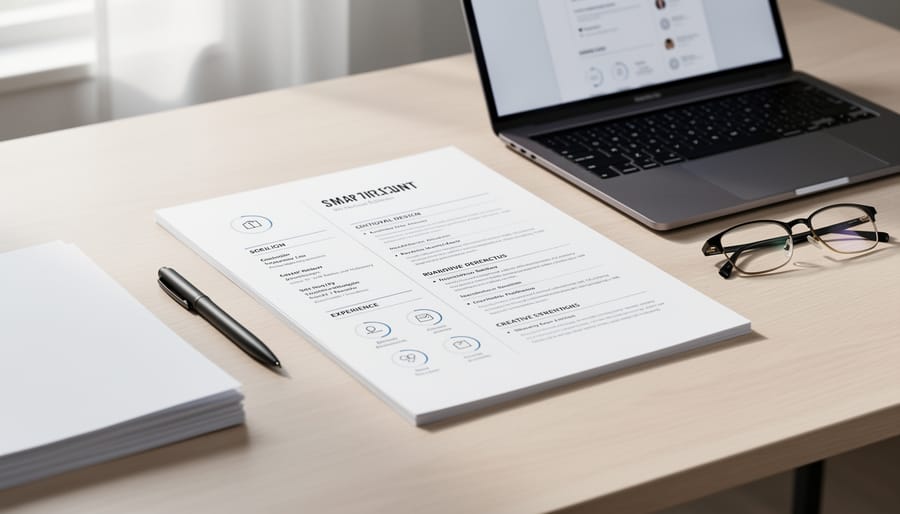
Your professional summary is the one place on a resume where you control the story. Think of it as a three-sentence pitch: who you are, what you’ve delivered, and where you’re headed. Skip adjectives like “passionate” and “dynamic.” Employers trust evidence, so lead with a specific strength and back it with a result.
The same discipline applies to your bullets. Start each with a strong verb, name the outcome, and cut anything that doesn’t earn its place. Aim for one or two lines per bullet. If a sentence needs rereading, it needs trimming.
Tone matters too. Keep it confident and warm rather than boastful, and write in plain language a recruiter can scan in seconds.
Consider a candidate whose summary read like a list of duties. After reframing it around outcomes and the kind of role they wanted, the summary told a clear story from start to finish. Recruiters began responding more often, and the candidate landed more interview invitations. The experience hadn’t changed, only the way it was told.
5. Adaptability and Learning Agility, Growing With Changing Technology
Technology moves fast, and employers know that today’s toolset may be obsolete in two years. Showing that you pick up new skills quickly can matter more than any single tool on your list. Back it with specifics: name the certification, the platform you moved to, or the team you joined, and attach a timeframe. “Earned a cloud practitioner certification in six weeks while covering a full support queue” says more than “fast learner.”
Cross-functional moves count too. If you shifted from support into QA or picked up data reporting to help a neighboring team, say so in one tight bullet with the result.
For design, a compact “Skills and Learning” block works well. Group tools by category, then add a small timeline showing when you adopted each one. Keep it to three or four lines, aligned cleanly, so a recruiter sees your growth trajectory at a glance without wading through dense text.
6. Collaborative Creativity, Generating Ideas With Teams
Collaborative creativity shows up on a resume when you describe how ideas moved from a rough concept to a shipped result. Start bullets with action verbs like “facilitated,” “co-developed,” “synthesized,” or “partnered,” then attach a team-level outcome: a cross-team project that cut onboarding time by a third, or a brainstorming series that produced a feature adopted by several departments.
The tricky part is giving credit without disappearing into the group. Use “we” sparingly and name your specific role. For example: “Led a four-person working group to redesign the intake process; proposed the triage model that reduced handoffs and now serves as the team standard.”
Mention stakeholder input too. Phrases such as “incorporated feedback from sales, support, and engineering” signal that you listen before you build.
Design tip: place a short “Team Projects” block beneath your experience, with the team size, your role, and one bolded result per line, so a recruiter can scan your contribution in seconds.
7. Design Thinking and User Empathy, Putting People First

User-centered thinking isn’t reserved for designers. A support specialist who spots the same complaint in ten tickets and reshapes the help article is practicing it. So is an HR coordinator who rewrites an onboarding flow after new hires say it felt confusing, or a developer who watches a user struggle with a form and simplifies it. Employers in high-tech and beyond want proof that you start with the person on the other end.
To show it, cite where your insight came from (interviews, surveys, support tickets, usability sessions), what you changed, and what improved. Here are resume-ready phrases to adapt:
- Interviewed 15 users to uncover friction points, then redesigned the intake process around their needs.
- Built a feedback loop from support tickets that cut repeat questions and shortened resolution time.
- Simplified the employee onboarding checklist after survey input, raising new-hire completion rates.
- Ran usability tests on a internal tool and prioritized fixes that reduced task time.
Swap in your own numbers and keep every claim honest. For the design side, add a clean, clickable URL to your portfolio or a project page in your header or Key Projects section, such as, so a reader can see the work behind the claim.
Creative Skills Resume Questions Answered
Do creative resume designs work with applicant tracking systems?
Only when the design stays simple. Use a single column, standard section headings, and real text rather than images or text boxes, since those can scramble when a system parses the file.
How many creative skills should I list?
Two or three, each backed by a result. Pick the ones closest to the job you want rather than spreading thin across all seven.
Do non-design roles benefit from showing creativity?
Yes. In IT, support, and HR, creativity shows up as better processes, clearer communication, and smarter fixes, which employers value alongside technical ability.
How can I prove creativity without a portfolio?
Describe the problem, what you changed, and the outcome. A tight project bullet or a clickable link to a case study is often more convincing than a gallery.
Which layout should you choose? That depends on where you’re applying. Conservative fields such as finance, law, and government usually favor a traditional layout, while startups, agencies, and product teams tend to welcome a bit more personality. When in doubt, lead with clarity and let your results carry the creativity. It also helps to meet people in the field, and attending a few networking events can show you what hiring teams in your target industry expect to see.
Creativity on a resume comes down to evidence and clarity, not flashy decoration. Start by choosing two or three of the skills above that best fit the role you want. Then back each one with a specific result, such as a problem you solved, a process you improved, or a team idea that made a measurable difference. A clean, readable design will carry those proof points far better than any visual gimmick.
At Northern Lights Canada, we see every day how creative, capable candidates stand out when their story is told clearly. We connect that talent with employers who value innovation, and we keep refining how recruitment works for both sides. If you’re a job seeker, explore our current opportunities and put these ideas to work. If you’re an employer, we’d welcome the chance to partner with you on a smarter, more forward-thinking approach to hiring.